
LEMO—AILegislationMonitoring
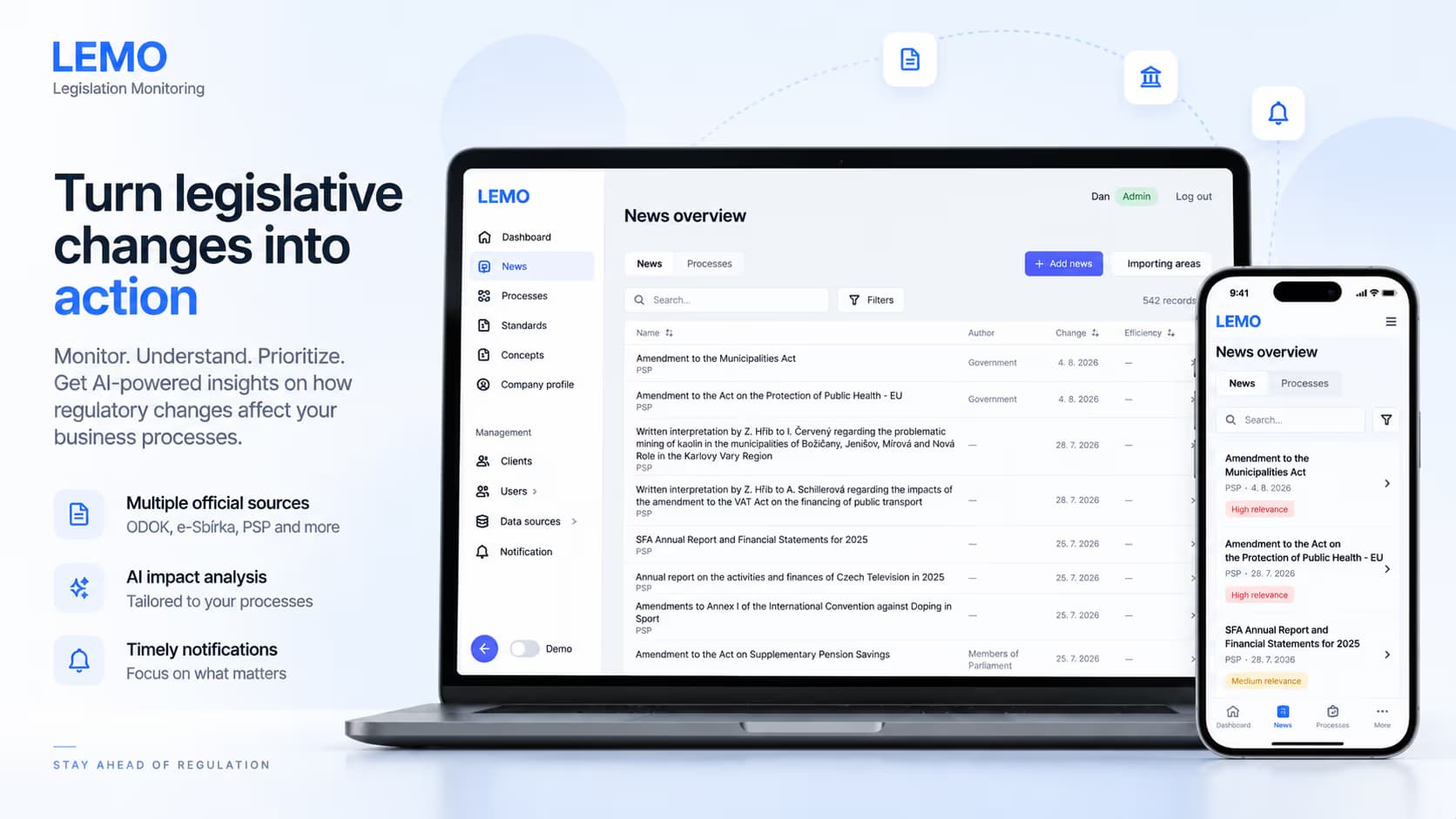
An AI-powered RegTech platform that helps companies monitor legislation, understand what changed and see how it may affect their internal processes. Devehope built the full-stack SaaS around that methodology.
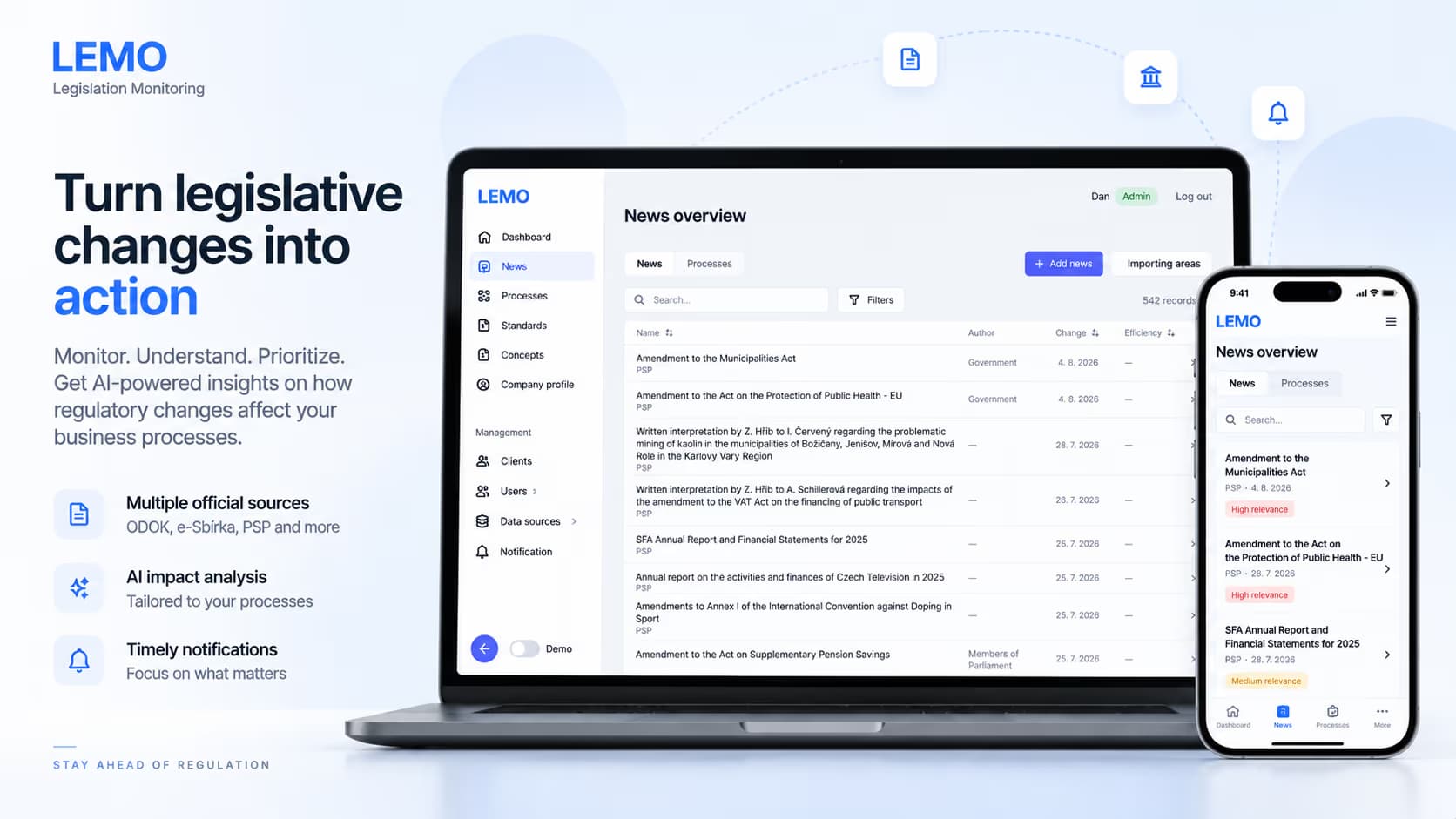
Technology
Monitoringlegislationisonlythefirststep
Regulated companies have to follow new laws, amendments, methodologies, decisions and guidance. The information exists, but it is spread across government systems, parliament, regulators and documents.
The real work starts after something changes: what actually changed, whether it is relevant, which obligations or processes are affected, and who needs to know. That often becomes manual monitoring, newsletters and specialist time spent filtering updates that never touch the company.
Source → change → relevance → impact → action
- 01
Official sources
Laws, amendments, guidance and decisions.
- 02
What changed
A structured reading of the development.
- 03
Relevance
Does it touch this organization?
- 04
Impact
Which obligations or processes are affected?
- 05
Action
Who needs to know, and through which channel?
Oneregulatoryintelligencelayer
LEMO brings sources including ODOK/EKLEP, the Chamber of Deputies and e-Sbírka into one environment, together with configurable monitoring of pages, lists, RSS feeds and sitemaps. Incoming information is transformed into a common model and connected with regulations, processes, concepts and source documents.
This is more than connecting a few APIs. Sources use different interfaces, identifiers, document structures and publication workflows, so the platform has its own ingestion, normalization and change detection.
- 1
ODOK · Parliament · e-Sbírka · regulatory websites
- 2
Ingestion and change detection
- 3
Normalized regulatory data
- 4
Company-specific analysis
MakinglegaldocumentsusablebyAI
A large part of regulatory information lives in PDF, DOCX and HTML. Before deeper reasoning, LEMO fetches the source, extracts normalized legal Markdown, splits it into chunks and classifies it for further analysis.
That preprocessing is a more predictable foundation than repeatedly handing arbitrary source files to a model.
- 01
PDF / DOCX / HTML
- 02
Extraction
- 03
Legal Markdown
- 04
Chunking
- 05
Classification
- 06
AI analysis
Multi-stageanalysis,notanothersummary
The model has to understand both sides: what a regulatory change means, and what it means for this organization. Analysis is therefore split into specialized stages instead of one prompt that tries to do everything.
- 1
Understand the company
The C2 layer maps relevant business processes into structured client-process relationships that can be reviewed.
- 2
Understand the legislation
C3 analyzes one development: the change, a detailed reading, effectiveness and affected regulations.
- 3
Identify affected processes
C4 finds generic process impacts, then combines them with the client context.
- 4
Client-specific impact
Process plus company context becomes an impact the organization can act on.
AIthatstaysinspectable
Regulatory analysis is high-stakes, so output cannot disappear into a black box. LEMO records individual analysis runs and supports inspection of the model, token consumption, execution trace and result preview.
Administrators can select models, override instructions for a run and review AI-generated process mappings and impacts in the application. AI handles the expensive reading and first pass. Specialists keep the decisions.
Regulationorganizedaroundthebusiness
Companies operate through processes, not lists of legislation. Each client has its own users, monitored regulations, processes, concepts and notification settings. AI can assist with process mapping, and administrators review and approve the resulting configuration.
The product can move the question from “what new legislation appeared?” to “what changed that may affect our processes?”. Relevant updates go out as scheduled email digests. The same analytics view shows how volume moves over time and how updates distribute across legal areas and processes.
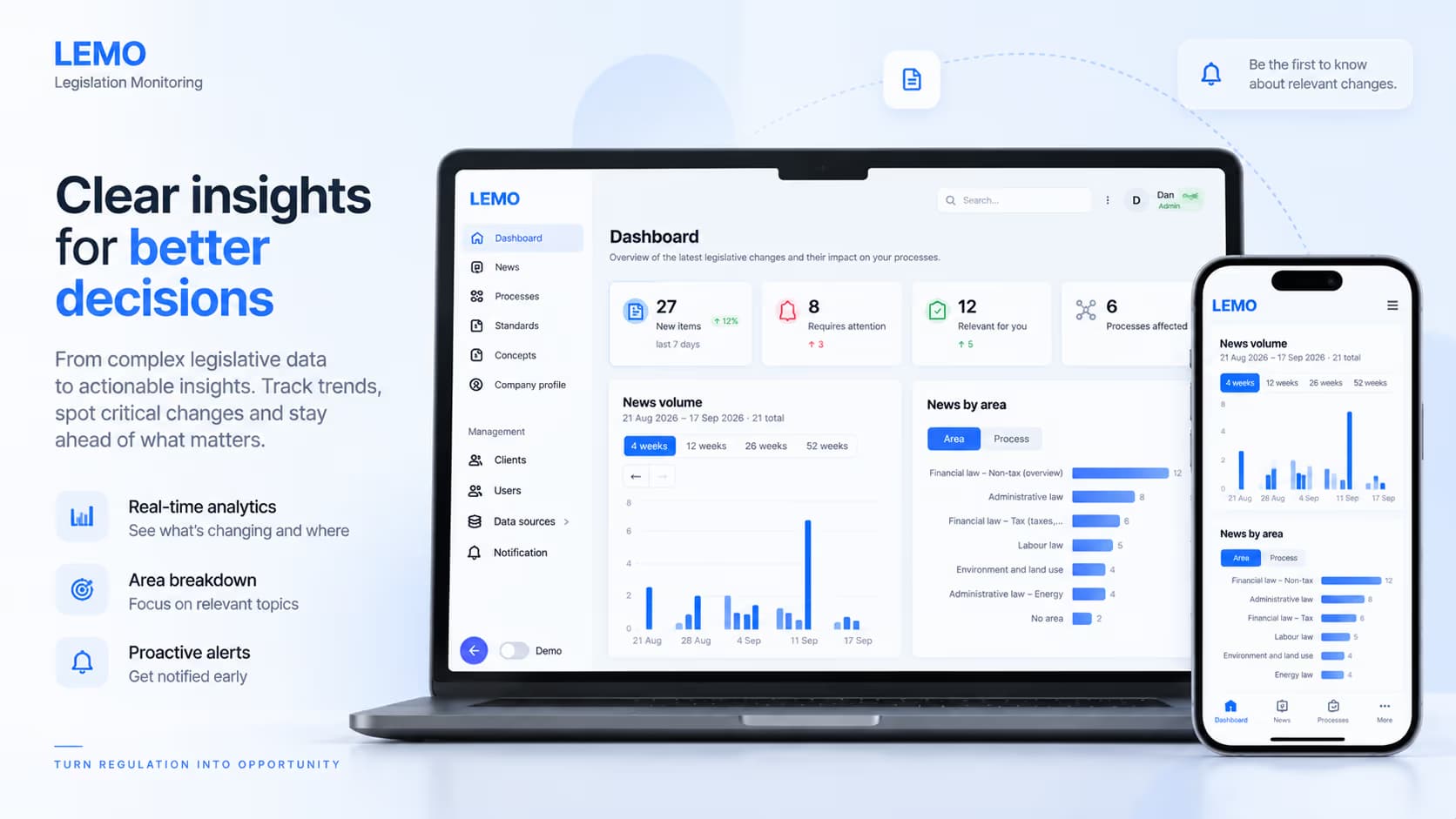
News volume
21 Aug – 17 Sep · illustrative view from the product analytics
News by legal area
Breakdown by legal area in the same illustrative window
- Financial law – non-tax12
- Administrative law8
- Financial law – tax6
- Labour law5
- Environment and land use4
- Administrative law – energy4
- No area2
Personalizationbeforethemainapplication
The demo flow combines passwordless access, an AI interview, a company profile and process mapping. LEMO can then run the same analysis pipeline against relevant developments and prepare an initial personalized digest. That removes much of the manual setup normally required before an enterprise monitoring product becomes useful.
- 01
AI interview
- 02
Company profile
- 03
Process mapping
- 04
Relevant analysis
- 05
Personalized digest
Acompleteproductionsystem
LEMO is not an isolated AI workflow. The customer application, administration, ingestion, document preprocessing, scheduled monitoring, agents, authentication and notifications sit around a PostgreSQL model. AI agents run in-process over the same application and data. Production is a standalone Next.js Docker app connected to PostgreSQL, regulatory sources and AI providers, deployed with Docker and Coolify.
- 1
Sources
- 2
Data ingestion
- 3
Document processing
- 4
PostgreSQL
- 5
AI agents
- 6
Relevance and impact
- 7
Dashboard and notifications
Devehope’srole
The regulatory methodology comes from specialists. Our work was the technical system around it.
Architecture and SaaS
Product and software architecture, the customer application and multi-client administration.
Sources and documents
Regulatory integrations, scraping, normalization and the document processing pipeline.
Agents with a review path
Multi-stage analysis, company-specific impact mapping and inspection of individual runs.
Production and notifications
Authentication, scheduled digests, Docker deployment and ongoing development.
Frommanualmonitoringtoastructuredintelligenceworkflow
LEMO brings fragmented sources together, processes complex legal documents, identifies potentially relevant changes and connects them to the context of individual organizations. Compliance, legal and risk teams spend less time finding and filtering information.
The difficult part was not adding an LLM to a legal database. It was designing the data, software and workflows that let AI operate usefully inside a regulated domain.
Selectedprojects
From regulated FinTech and RegTech platforms to AI systems, marketplaces, and large e-commerce ecosystems.



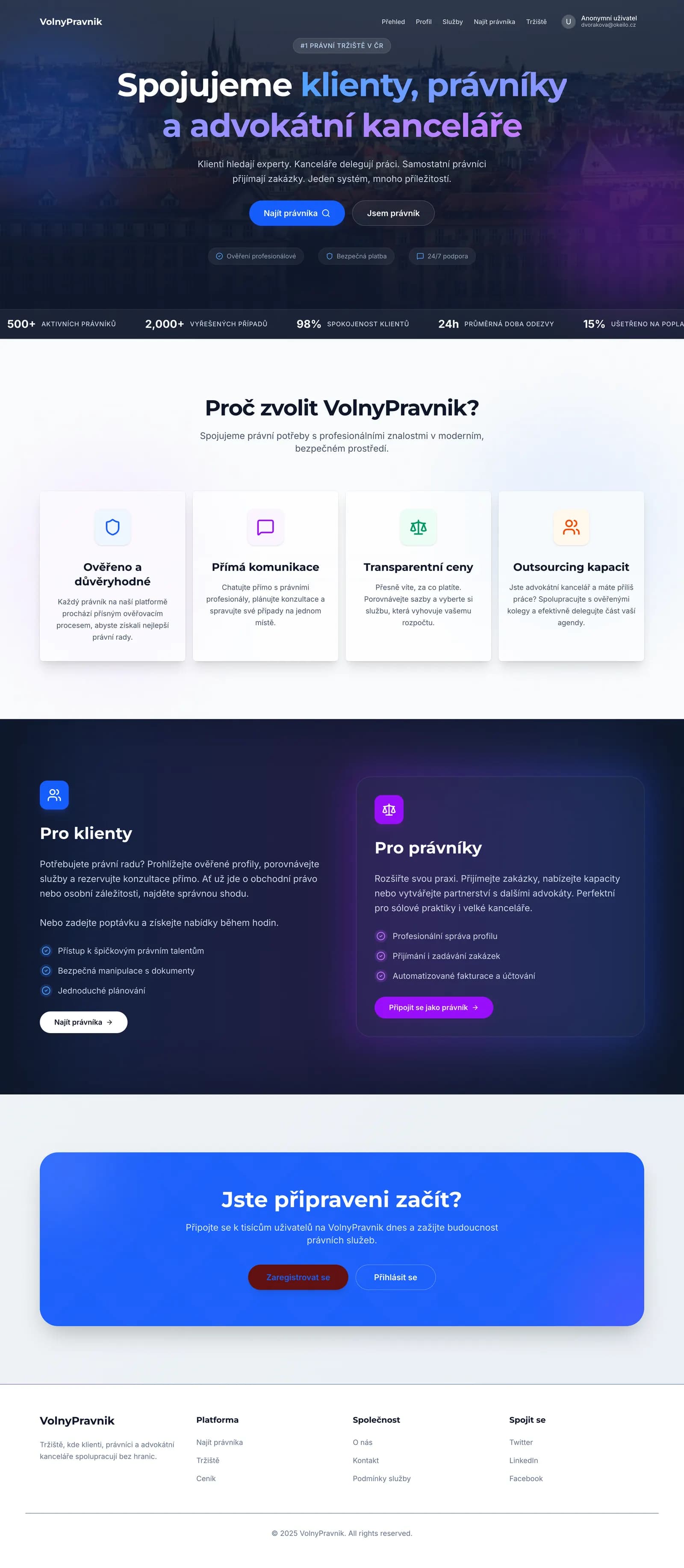
Lawyers Marketplace
Website and marketplace platform for attorneys and law firms