
NukiE-CommerceEcosystem
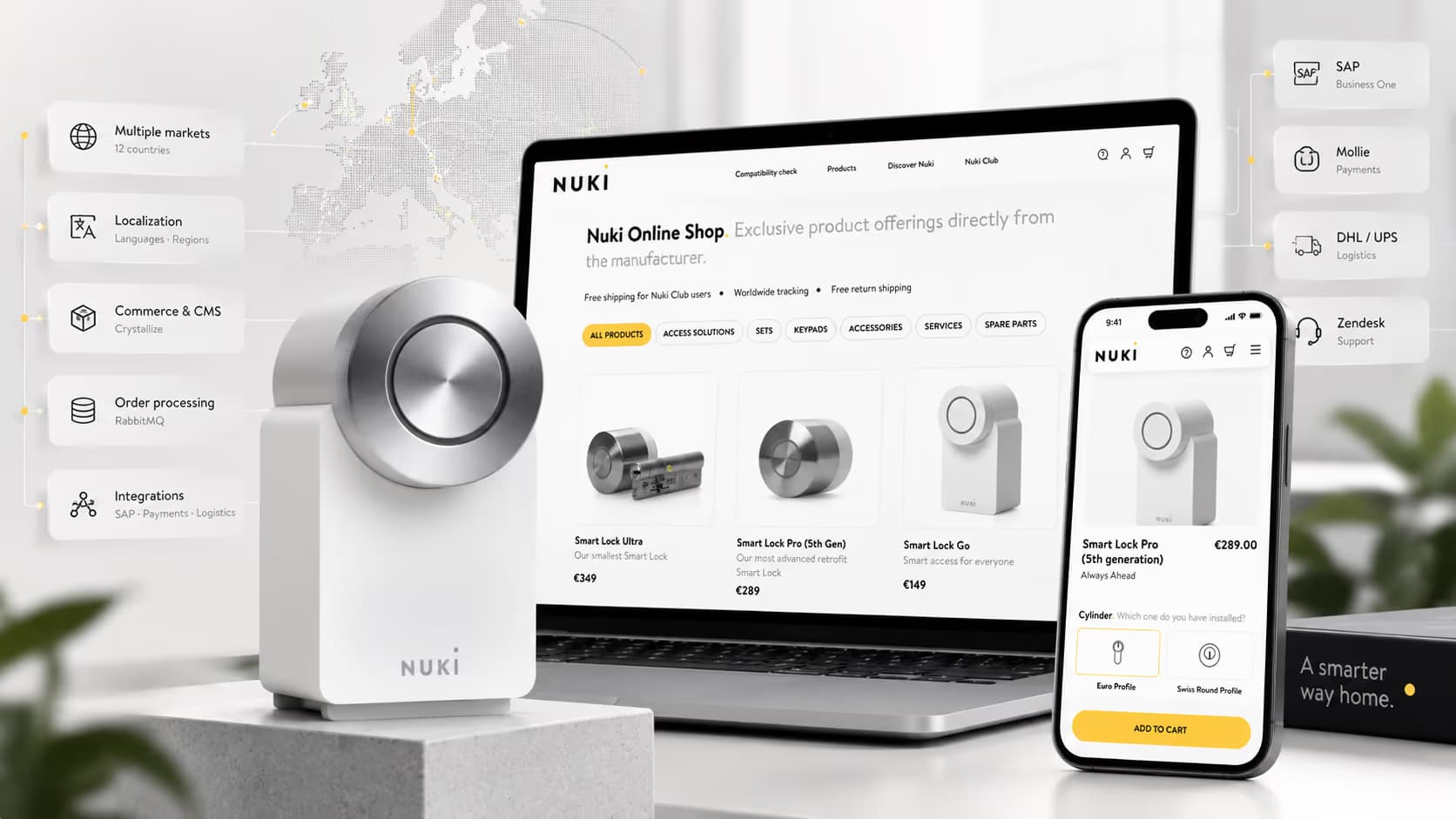
A multi-year rework of Nuki’s e-commerce ecosystem. Twelve country-specific shop setups and tightly coupled systems were replaced with a composable architecture built for international growth.
Technology
Commercethathadoutgrownaconventionalshop
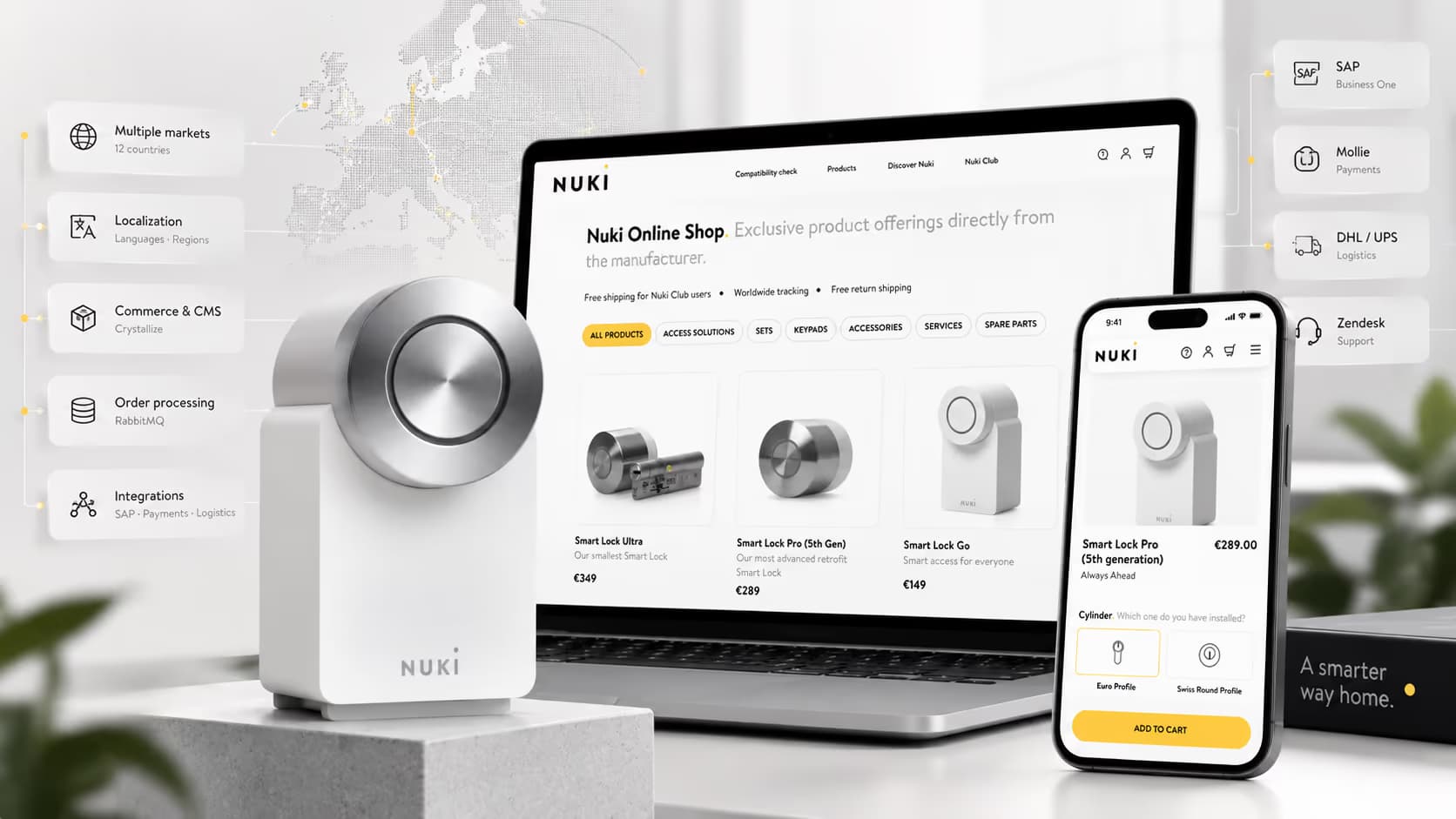
Nuki is an Austrian smart-access company and a European market leader in retrofit smart locks. As it expanded, the online sales platform had to handle different products, stock, prices, taxes, warehouses, payments and shipping rules, plus content in multiple languages and reliable synchronization with SAP Business One, payments and logistics.
The existing architecture had accumulated country-specific shops, WordPress and WooCommerce, plugins and tightly coupled integrations. From 2023 to 2025 we worked with Mashed Software Solutions and Nuki’s internal teams on a redesign of commerce, content, localization, inventory, identity and order processing.
Nuki reported more than 50% year-on-year sales growth in 2023 and later exceeded 800,000 customers across Europe. The commerce ecosystem serves millions of visits and a multi-million-euro direct sales operation.
Problemsthatcouldnotbepatchedonebyone
Solving each constraint in isolation would have added another layer of exceptions. The larger task was to redesign how the systems fit together.
- Twelve country-specific commerce setups meant duplicated work
- Language, country and physical delivery location were coupled too tightly
- Stock, availability and delivery information were hard to keep consistent
- SAP throughput constrained synchronous order processing
- Product data and marketing content were fragmented
- Content teams needed developers for new pages and campaigns
- Promotions, bundles and configurations were difficult to evolve
- Authentication and legacy internal tools needed a stronger boundary
Onearchitectureinsteadof12shops
The principle was simple: do not duplicate shops. Model the rules that make markets different. Clear boundaries now separate customer experience, content, commerce data, operational logic and external integrations.
- 1
Next.js storefront
Customer experience and rendering.
- 2
Crystallize
Headless commerce, PIM and CMS over GraphQL.
- 3
Service API
Backend business logic and integrations.
- 4
RabbitMQ
Asynchronous processing with retries and dead-letter queues.
- 5
Warehouse and promotion apps
Focused tools where the workflow is specific to Nuki.
- 6
Ory identity
Sessions, 2FA and account lifecycle, separate from commerce.
- 7
External systems
SAP, Mollie, DHL, UPS and a compatibility API for legacy tools.
Language,marketanddeliverybecameseparateconcepts
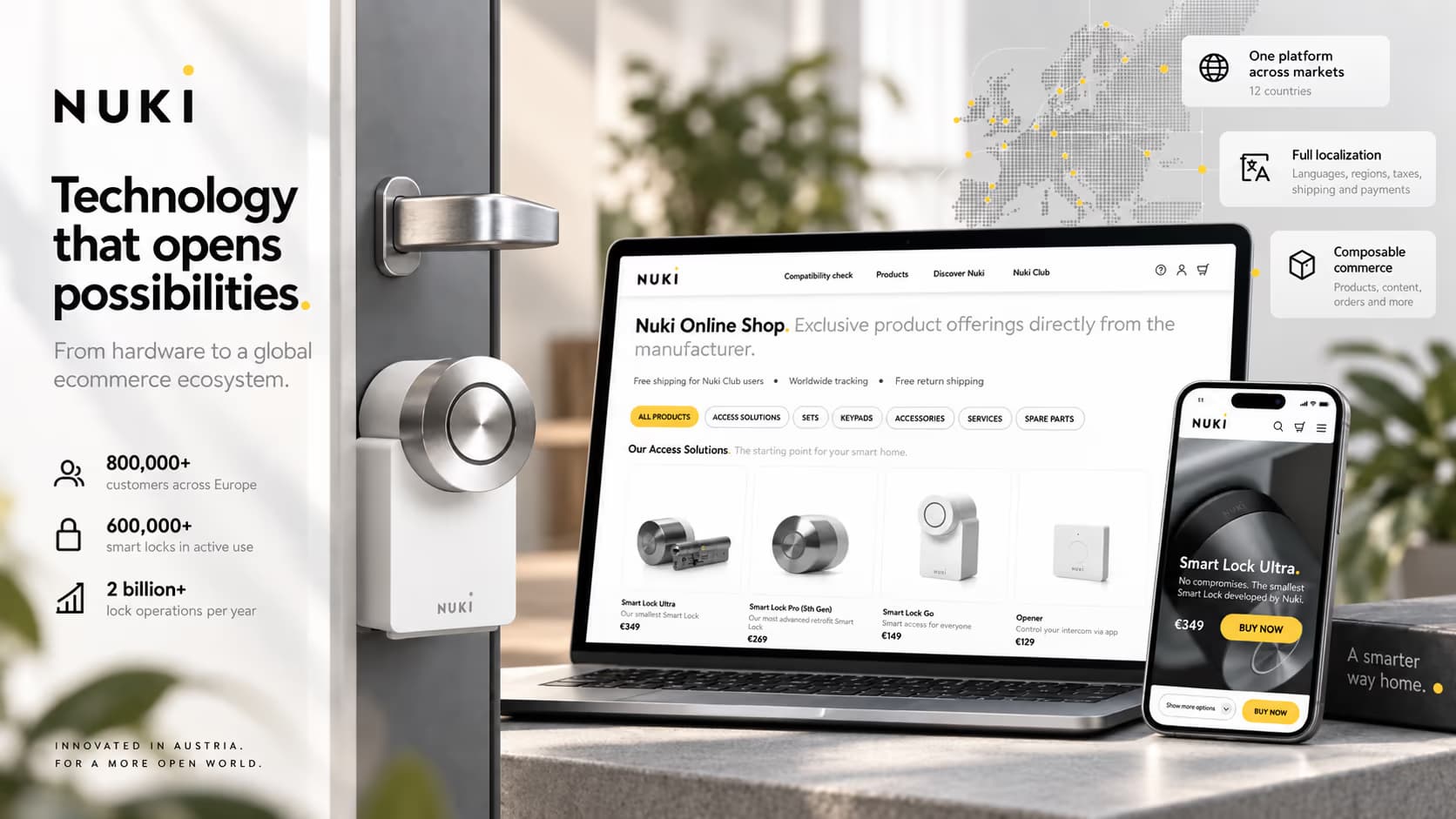
Language determines content and translations. Country represents the commercial market. Area represents the physical geography relevant for fulfillment, taxation and payment rules. Customers can use different languages inside the same market without duplicating the shop.
Country-level configuration was not always precise enough. Continental Spain and the Canary Islands can need different shipping and tax handling, and similar rules can apply to individual US states. An Area can influence product and warehouse availability, delivery methods, VAT and reverse charge, payment options and associated costs.
Translated content is resolved separately through CMS translations, Weblate-managed application strings, fallbacks and redirects.
- 01
Language
Content and translations.
- 02
Country
The commercial market.
- 03
Area
Physical geography for tax, shipping and payments.
- 04
Warehouse → delivery zone → area
How stock and delivery expectations reach the customer.
Commercial rules and fulfillment rules are explicit instead of hidden in country-specific storefronts.
CheckoutnolongerwaitsontheERP
SAP Business One stayed critical, but some integration paths were effectively around one transaction per minute. A synchronous implementation would have made ERP throughput a direct constraint on checkout.
Orders became explicit stateful processes. An order spans systems that cannot share one database transaction: SAP can be unavailable, a carrier can reject a request, a payment event can arrive twice, and a downstream call can succeed while its response is lost. Failure and recovery are normal parts of the workflow.
- Explicit order states
- Retries and dead-letter queues
- Processing visibility, observability and operational alerts
- 01
Checkout
- 02
Order created
- 03
Queue
- 04
Service API
- 05
SAP
- 06
Payment and fulfillment
- 07
DHL / UPS
- 08
Support
Asynchronous order lifecycle
Editorscomposepages.Developerskeepthecomponents.
Crystallize became the headless commerce, PIM and CMS layer. On top of it we introduced Tiles: predefined content and interaction components such as heroes, product presentations, comparisons, media, calls to action, collections and campaign blocks.
A CMS Tile becomes configuration, then a Tile renderer, then a React component. Editors control structure and content. Developers keep control of quality and behavior. CMS folders and nested paths let teams create page hierarchies without a dedicated frontend route for every page.
A dedicated warehouse application manages warehouses, availability, stock, delivery zones and delivery expectations through Crystallize APIs, with workflows shaped around Nuki’s operations. The pattern throughout: use platforms for generic capabilities, and build focused software where the business workflow is specific.
CMS Tile → configuration → Tile renderer → React component
Promotions,bundlesandidentityhadaplacetolive
A promotion application configures rules around country, language, currency, products, categories, bundles, usage limits, customer-specific links, validity, cart value and required combinations. Voucher validation runs through a central API instead of being copied through the storefront.
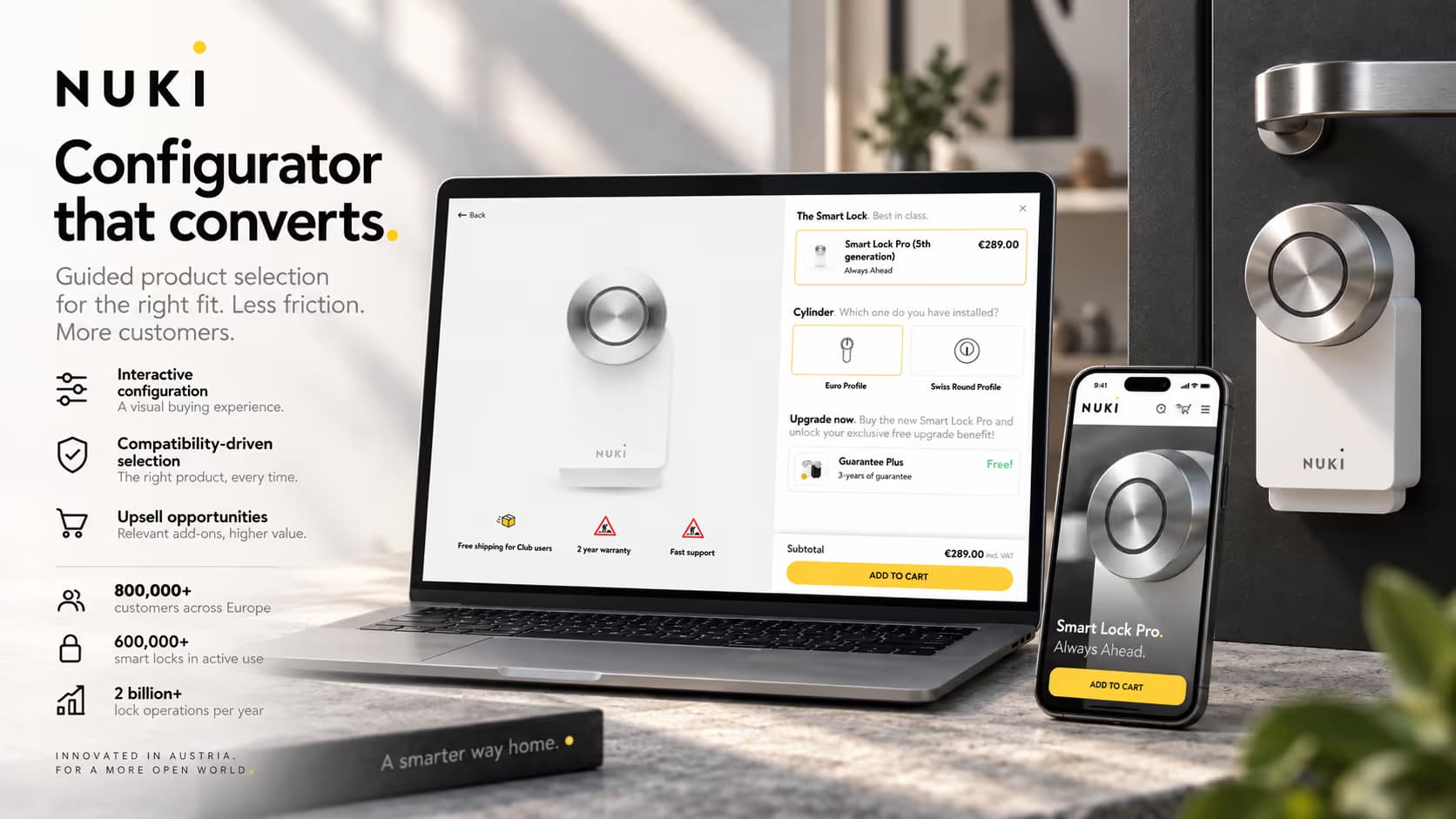
Bundles used to be fixed ERP SKUs. They are now combinations of existing products: the customer sees one offer, while the order still contains the underlying products required for inventory and fulfillment. Crystallize variants support configurable smart locks without a page for every combination.
Referrals connect to the order lifecycle through Antavo. New subscription flows use Mollie. Authentication sits in an Ory-based identity layer with secure sessions and two-factor authentication.
Afullstorefrontcutover,withabridgeforlegacytools
The customer-facing storefront moved through a coordinated full cutover. Some internal Nuki applications still depended on older interfaces, so a compatibility API translated legacy requests to the new Service API. The shop could move forward without forcing every connected internal system to change at the same time.
Whatchanged
One shared international platform
Twelve country setups moved onto a common architecture while keeping market-specific rules.
Structured localization
Language, commercial market and physical fulfillment location are separate concepts.
More resilient processing
ERP throughput and temporary downstream failures no longer have to block checkout.
Dedicated operational tools
Warehouse, stock, delivery and promotions gained software shaped around the workflow.
Greater content independence
Teams compose rich pages from reusable components without a frontend change for every campaign.
Clear technical responsibilities
Authentication, content, fulfillment, promotions, ERP and legacy compatibility are separated.
ArchitecturedeliveredwithNukiandMashed
The ecosystem was delivered between 2023 and 2025 by Nuki Home Solutions, Devehope Technologies and Mashed Software Solutions. Devehope focused on technical architecture and implementation. Mashed led project management, coordination and the client relationship. Nuki’s engineering team contributed especially around SAP integration and selected parts of the Service API.
New requirements no longer have to become another plugin or another market-specific exception. The commerce operation is easier to reason about and extend.
Selectedprojects
From regulated FinTech and RegTech platforms to AI systems, marketplaces, and large e-commerce ecosystems.



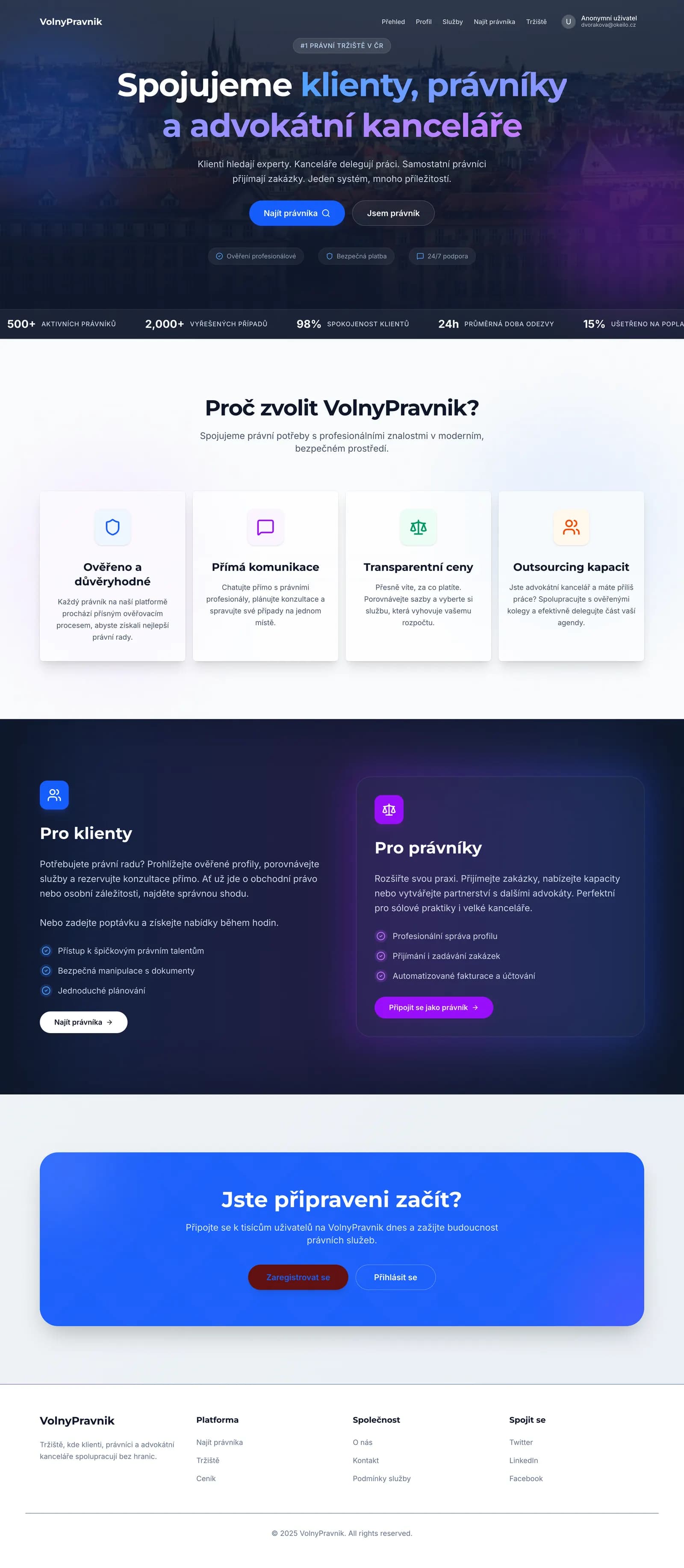
Lawyers Marketplace
Website and marketplace platform for attorneys and law firms